Wrapping a Large Language Model (LLM) in a chat interface is a solved problem. Building autonomous, multi-step AI agents for production is where the pain actually begins.
You hand an agent an objective, equip it with a suite of APIs, and deploy it to a staging environment. Thirty minutes later, you discover it fell into a recursive logic trap, hammered your legacy database with 4,000 malformed query payloads, and vaporized your monthly token budget. The intelligence of your underlying model isn’t the problem. The absolute lack of Enterprise AI Agent Infrastructure is the problem.
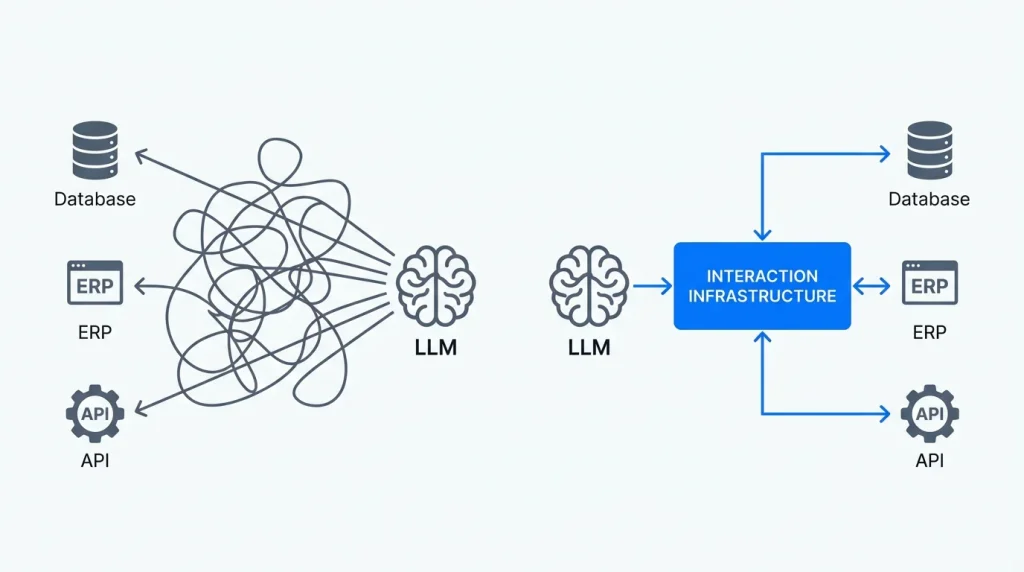
As organizations graduate from local Python scripts to production-grade deployments, the focus must shift. We have to stop obsessing entirely over context windows and start building a rigorous middleware layer to govern, coordinate, and supervise non-deterministic code. Without robust interaction infrastructure, autonomous agents are just massive liabilities waiting to execute.
The Infrastructure Gap: Execution Over Intelligence
Most engineering conversations around AI right now center on model benchmarks, reasoning capabilities, and inference latency. But in an enterprise environment, a model’s IQ is strictly secondary to the reliability of its execution. An intelligent agent that cannot reliably authenticate with an internal ERP system is useless.
For an autonomous agent to generate actual business value, it has to interact with legacy systems, trigger third-party webhooks, and hand off tasks to specialized peer agents across distributed cloud environments. When developers skip building an orchestration layer, these agents operate in isolated silos.
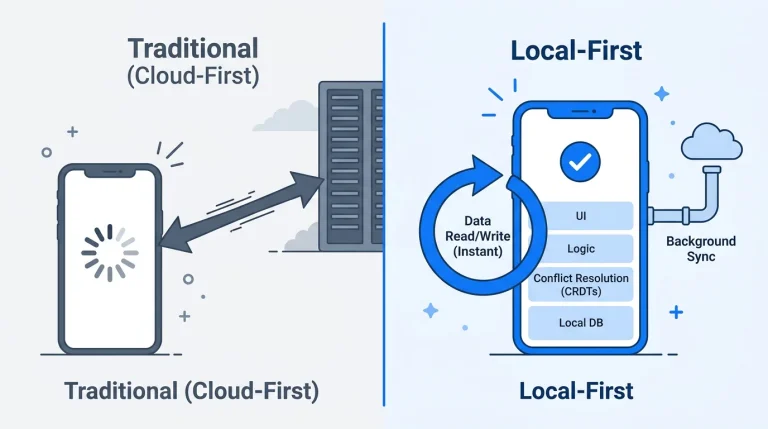
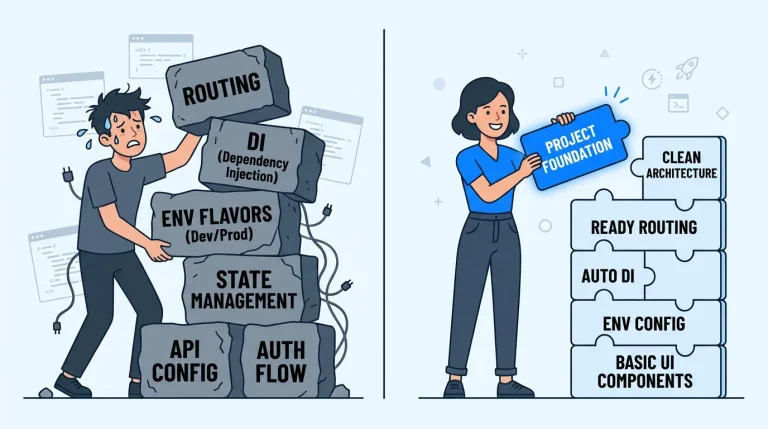
Building this orchestration layer from scratch is a massive trap. Much like attempting to hand-roll a custom state management solution or a local-first CRDT syncing engine, writing custom agent infrastructure drains months of engineering resources. This is exactly why agencies and development teams rely on production-ready SaaS-in-a-Box bundles and templates like the architectures we build at Stacklyn Labs. Bypassing the boilerplate lets you ship features that generate revenue, rather than fighting foundational architecture.
The Disease of Automation Waste
When agents lack proper supervision, they generate a phenomenon called Automation Waste. This happens when non-deterministic software gets confused and starts consuming heavy compute resources without progressing toward its goal.
Agents experience hallucination loops. They repeatedly attempt the same failing tool call. They navigate circular reasoning paths, forgetting the results of previous actions, and constantly re-querying identical data sets. To mitigate this, developers need a middleware layer that functions almost identically to a service mesh in microservices. It must manage traffic, enforce rules, and observe behavior, but it must be tailored for the probabilistic nature of LLMs.
Governance as Code: Guardrails for Probabilistic Systems
Enterprise software demands strict governance. Deterministic code fails predictably. AI agents fail creatively. They often attempt to solve logic puzzles in ways that directly violate internal security protocols or data compliance rules.
Robust interaction infrastructure acts as a centralized policy engine. It forces agents to operate within tightly defined boundaries before any network request actually leaves the environment.
Identity and Access Management (IAM) for Machines
You cannot let an agent run on administrative credentials. A scalable infrastructure assigns machine-to-machine identities to individual agents. We must scope these identities based on the principle of least privilege. If a research agent only needs read-access to a vector database, the infrastructure issues ephemeral tokens that explicitly block write operations.
Circuit Breakers and Cost Controls
Agents will hallucinate API calls. Your infrastructure must catch this before your cloud provider bills you for the traffic. Developers need to implement strict rate limiting and automated circuit breakers. If an agent hits an endpoint with a 400 Bad Request three times in succession, the infrastructure should sever the connection, kill the process, and log an error for a human developer.
Human-in-the-Loop (HITL) Checkpoints
Some actions are simply too dangerous to automate fully. Modifying a production database schema, sending bulk emails to clients, or initiating financial transfers require absolute certainty. The orchestration layer must recognize these high-risk tool calls, pause agent execution asynchronously, and trigger a webhook for human authorization before proceeding.
Context Exchange and the State Management Nightmare
Maintaining state across geographically distributed environments is arguably the hardest part of building agentic workflows. An agent might begin its reasoning loop on a local secure server, query an AWS-hosted vector database, and then attempt to trigger a transaction in a Microsoft Azure cloud environment.
Standardized interaction infrastructure provides a unified context exchange protocol. Passing context isn’t just about dumping a massive string of previous prompts into the next payload. It requires the structured sharing of the agent’s execution history, its active plan, and essential metadata.
Without a rigid protocol, systems experience context drift. The agent effectively develops amnesia as it hops between microservices. It loses the original intent of the user or fails to recognize the data it just fetched.
Emerging open-source standards are attempting to solve this. Anthropic’s Model Context Protocol (MCP) provides a standardized way for agents to securely connect to external data sources. But enterprises still need an overarching state machine to handle task retries, data persistence, and distributed locking. Again, fighting cross-node syncing issues is a notorious time-sink. Utilizing feature-first, offline-capable templates designed by teams who have already solved these state management nightmares like the Stacklyn Labs mobile architectures keeps your team focused on product logic, not debugging race conditions.
Observability: Moving to “Agentic Tracing”
In standard DevOps, you use observability tools to monitor CPU spikes or memory leaks. In an agentic environment, observability is the only thing keeping your application economically viable. You cannot optimize what you cannot see.
Basic console logging fails when debugging autonomous agents. You need Agentic Tracing. This concept goes beyond recording HTTP status codes; it involves visualizing the internal “Chain of Thought” of the LLM right alongside its external network requests.
By pushing these traces into a visualization dashboard via OpenTelemetry, developers can watch the exact reasoning path the agent took. You can see the precise moment the agent misunderstood a variable, formatted a JSON object incorrectly, and subsequently crashed the workflow. Real-time tracing allows the infrastructure to intervene dynamically, stopping a bad run before it burns unnecessary tokens.
Breaking Silos with Standardized Protocols
For agentic software to mature, the industry has to prioritize interoperability. Right now, the ecosystem is highly fragmented. An agent coded in LangChain struggles to pass structured data to an agent built using CrewAI. This prevents the creation of complex, multi-agent ecosystems where specialized bots collaborate.
Interaction infrastructure serves as a universal translator. By adopting standardized communication guidelines like the Agent Protocol incubated by the AI Engineer Foundation developers guarantee that a specialized “Research Agent” can hand off a structured JSON payload to a “Writing Agent” without friction.
This modularity is non-negotiable for enterprise teams. It allows architects to swap out underlying models or migrate frameworks without completely destroying the entire production pipeline.
The Multi-Cloud Reality and Data Gravity
Large organizations rarely keep their data in one place. They operate in multi-cloud and hybrid environments. Because of this, your AI agent infrastructure must be completely cloud-agnostic.
Engineers have to respect the concept of data gravity. Moving a ten-gigabyte dataset across the internet to reach an LLM endpoint is slow, expensive, and insecure. Moving a lightweight agent’s reasoning logic to the server where the data already lives is highly efficient. A modern orchestration layer intelligently routes agent sub-tasks to the specific environment holding the necessary data. This architectural decision slashes network latency and practically eliminates massive egress bandwidth fees.
Stop Rebuilding the Wheel
The Large Language Model is simply the brain. The interaction infrastructure is the nervous system. It is the framework that allows the brain to actually move muscles, sense its environment, and obey the laws of physics.
As you transition your team past the experimental pilot phase, stop trying to build smarter individual agents. Start building a smarter environment for those agents to operate inside. Adopt standardized context protocols, enforce rigorous rate limiting, and implement deep tracing. If you lack the engineering cycles to build these complex, state-heavy architectures from the ground up, lean on production-ready templates and SaaS bundles to accelerate your timeline. The winners in the next era of software won’t be the teams with the best prompts; they will be the teams with the most resilient infrastructure.
References & Further Reading
- Anthropic: Introducing the Model Context Protocol (2024)
- AI Engineer Foundation: The Agent Protocol (2023)
- Gartner. (2024). “Top Strategic Technology Trends for 2025: Agentic AI.”
- Microsoft Research: AutoGen – Enabling Next-Gen LLM Applications via Multi-Agent Conversation (2024)
Stacklyn Labs
Developer Notes & Updates