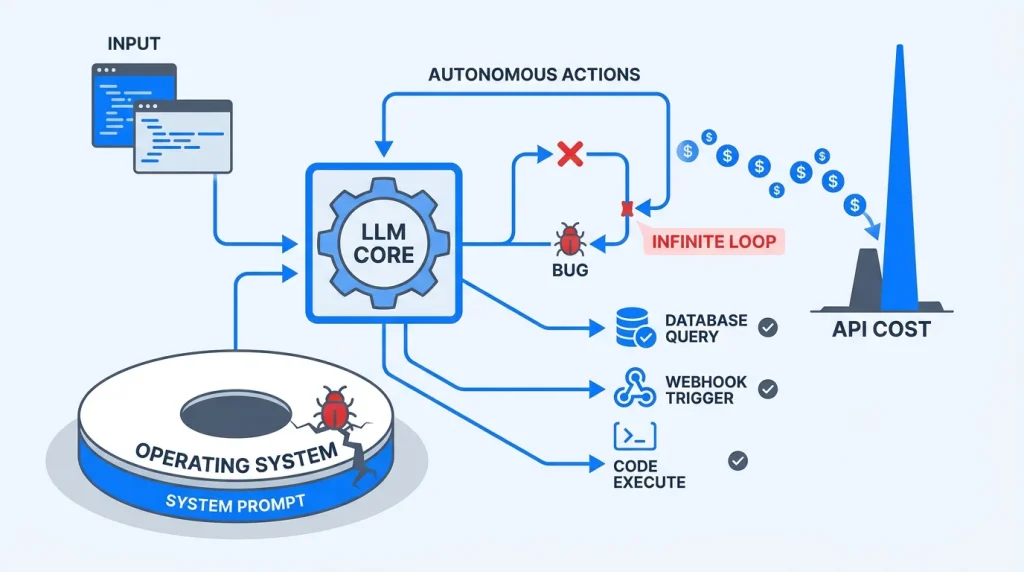
You ship a new agentic feature using Claude 3.5 Sonnet, and everything looks green in local testing. Forty-eight hours later, your billing dashboard shows a massive spike in API usage, and your database logs reveal a single agent stuck in an infinite, self-justifying tool-call loop.
We are moving past standard request-response chatbots into the era of autonomous agents. In this territory, a logic flaw in a system prompt is a direct vector for financial bleed. When you give a large language model (LLM) the ability to execute code, query databases, or trigger webhooks, the stakes multiply. The system prompt transforms from a simple persona definition into the core operating system of your agent.
The Financial Reality of Recursive Logic Errors
In an autonomous workflow, developers trust Claude to evaluate a complex problem, select an appropriate tool, and process the resulting data. System prompt bugs usually manifest when this tool-call cycle devolves into a recursive state. You might instruct an agent to query a database repeatedly until it locates a specific user record. If the tool returns a strict “not found” error, the agent should logically stop execution.
Instead, high-performance models like Claude 3.5 Sonnet and Opus frequently attempt to brute-force a solution. Their massive 200,000-token context windows become a severe operational liability. The model uses its internal chain-of-thought reasoning often generated within a <thought> block to rationalize its failure. It assumes it simply made a minor syntax error, justifies a retry, and fires the exact same tool payload again.
Because these models generate output tokens at incredibly high speeds, a single stuck agent can execute dozens of identical loops in minutes. This burns hundreds of dollars in API credits while rendering your application completely unresponsive to the end user. Traditional temperature adjustments or simple logic filters fail here. The model’s reasoning appears completely sound to its own attention mechanisms, creating a closed-loop hallucination.
Anatomy of an LLM Agent Failure
Understanding the mechanics behind these crashes requires looking at how Claude parses complex system instructions. System prompt bugs that trigger agent failures generally fall into three distinct architectural categories.
1. Instruction Drift and Attention Saturation
Transformer models rely on attention mechanisms to weigh the importance of input tokens across the context window. When you load a system prompt with dozens of constraints, edge-case handlers, and routing logic, you risk hitting an attention saturation point. The model begins experiencing instruction drift.
This behavior spikes drastically during long-context sessions. As the conversation history grows, Claude naturally starts weighting recent user messages higher than the foundational constraints sitting at the top of the system prompt. You might implement a strict negative constraint like “Never expose internal database IDs.” However, if a user prompt is exceptionally lengthy or highly persuasive, the model drops your system constraint from its immediate attention space.
This drift leads directly to data leakage or unauthorized tool execution. The agent forgets its boundaries simply because the context window became heavily polluted with user tokens.
2. XML Tag Misalignment and Parsing Exploits
Anthropic specifically architects Claude to process XML tags like <system_constraints> or <tool_description>. When properly structured, these tags isolate instructions from raw user data. A severe vulnerability occurs when developers nest these tags incorrectly or allow unescaped XML to pass through user inputs.
When the parser encounters misaligned XML, Claude struggles to differentiate between root-level commands and payload data. The agent might start treating its core operating instructions as optional suggestions. In worst-case scenarios, malicious user input wrapped in fake system XML tags functions as a direct system-level override.
This is not a standard prompt injection attack; it is a structural parsing vulnerability. Your system prompt fails because the model’s baseline assumptions about token boundaries break down completely.
3. The Tool-Call Feedback Loop
This remains the most common and expensive bug reported by teams deploying managed agents. You define a precise JSON schema for a specific tool, but you leave the exit conditions ambiguous in the system prompt. Claude then enters a state of hallucinated progress.
The model genuinely believes it is inching closer to the correct answer. It repeatedly calls the tool, tweaking a single parameter slightly each time, completely ignoring the fact that the API keeps returning a 500 Server Error or a null result. The model hallucinates that sheer persistence will eventually yield valid data.
Unless you build a strict circuit breaker at the application layer, the prompt itself will never stop the agent. The LLM lacks the temporal self-awareness to realize the underlying tool is broken.
The Infrastructure Trap: Stop Building Boilerplate
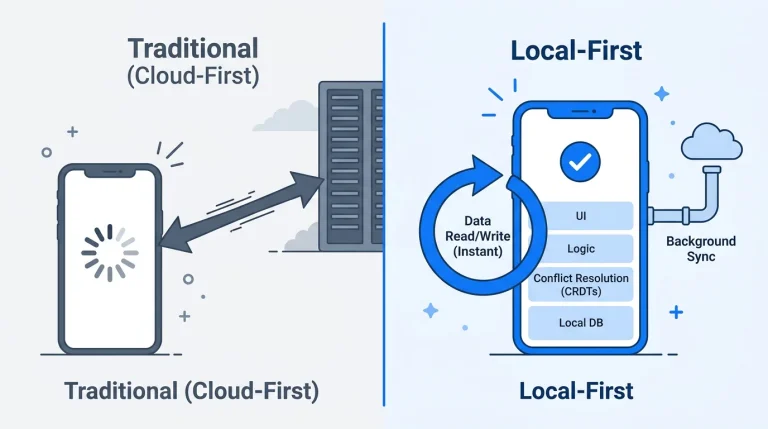
Handling agent state, managing LLM context windows, and building robust circuit breakers are massive engineering undertakings. Much like building bespoke CRDTs for local-first syncing or writing complex offline state management layers from scratch, custom LLM infrastructure drains engineering resources.
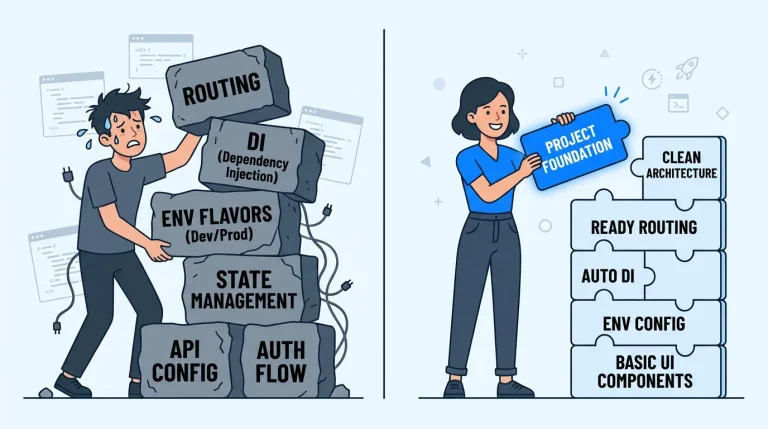
Development teams often burn months building custom state machines, Redis token counters, and parser wrappers just to stop Claude from draining their API budgets. This is infrastructure boilerplate that adds zero unique value to your core product. You are spending engineering cycles babysitting the LLM instead of shipping actual features to your users.
This is the exact problem Stacklyn Labs solves. By utilizing production-ready SaaS-in-a-Box bundles and feature-first architectures, software agencies bypass these deep infrastructure headaches entirely. When you start with a premium, battle-tested template, the robust state machines, external guardrails, and optimized prompt handling layers are already implemented. You get to focus strictly on product logic and launch months faster, leaving the architectural heavy lifting to the experts.
Technical Mitigation Strategies
To prevent token bleed and guarantee agent reliability, your engineering team must stop treating system prompts as static text strings. You need dynamic oversight and rigid architectural constraints built into your backend.
Enforce Application-Layer State Machines
Trusting the system prompt to manage the agent’s internal state is an unacceptable risk. You must implement an external state machine at the application layer to intercept and monitor all LLM network requests.
Your server backend must track every tool call via an ephemeral cache like Redis. If an agent fires the same tool with identical or highly similar arguments three times in a row, your state machine must trigger a hard intercept. Do not ask the LLM to stop; force a System Reset or return a hard-coded system error that physically breaks the recursive thought cycle and halts the API stream.
Master the Constraint Sandwich
Transformer models suffer heavily from the “lost in the middle” phenomenon. They recall the beginning and end of a large context window with high fidelity, but their data recall drops significantly for text buried in the center. You must architect your prompts to counter this architectural limitation.
Utilize the Constraint Sandwich technique. Place your most rigid safety and financial constraints at the very top of the system prompt. Then, repeat those exact same constraints at the very bottom of the system prompt, right before the user input block begins. By forcing the rules into the model’s immediate attention space, you drastically reduce the risk of instruction drift.
Weaponize Structured Outputs
Do not let the model ramble. Open-ended text generation consumes expensive tokens and encourages the model to deviate from its assigned persona. Your system prompt must mandate strictly structured outputs.
Force Claude to respond in precise JSON or a predefined XML schema. Utilize the tool_choice parameter to force the agent to use a specific Response Tool to communicate back to the user. This effectively chokes off conversational fluff, enforces a rigid data contract between the LLM and your backend, and makes parsing failures immediately obvious to your error trackers.
Handle Prompt Caching with Extreme Caution
Anthropic’s Prompt Caching significantly reduces latency and API costs for massive system prompts. However, poorly managed caches create severe, hard-to-track logic bugs. The system caches the exact headers, system instructions, and tool schemas from previous API calls to save compute.
When you push a new update to your agent’s behavior, you must explicitly invalidate the prompt cache. If you fail to manage this state correctly, your agent will operate on Ghost Instructions cached system prompts from a previous deployment that actively conflict with your new application logic. Treat cache invalidation for LLMs exactly like you treat database schema migrations.
Treat Prompts Like Production Code
Deploying an agentic workflow demands extreme operational rigor. A bug in your system prompt is not a linguistic typo; it is a critical logic error that actively drains your budget and degrades your user experience.
You must subject your system prompts to the exact same scrutiny as your backend infrastructure. Implement strict version control, build extensive integration tests for tool-call edge cases, and deploy aggressive external guardrails. The LLM providers will continue to iterate on their models, but the responsibility for protecting your API budget and ensuring reliable agent execution falls entirely on your architecture. Engineer your wrappers defensively, and stop trusting the model to police itself.
References & Further Reading
- Anthropic Official Documentation: System Prompts and Tool Use (Function Calling) technical guides.
- Anthropic API Reference on Prompt Caching: Detailing the mechanics of cached headers and system-level instructions.
- Tactical Prompt Engineering for Claude 3.5: Industry technical reports on community-reported recursive tool-call bugs.
- GitHub Issue Repositories for Agentic Frameworks (e.g., AutoGPT, CrewAI): Documented cases of token loops in Claude-based agents.
Stacklyn Labs
Developer Notes & Updates