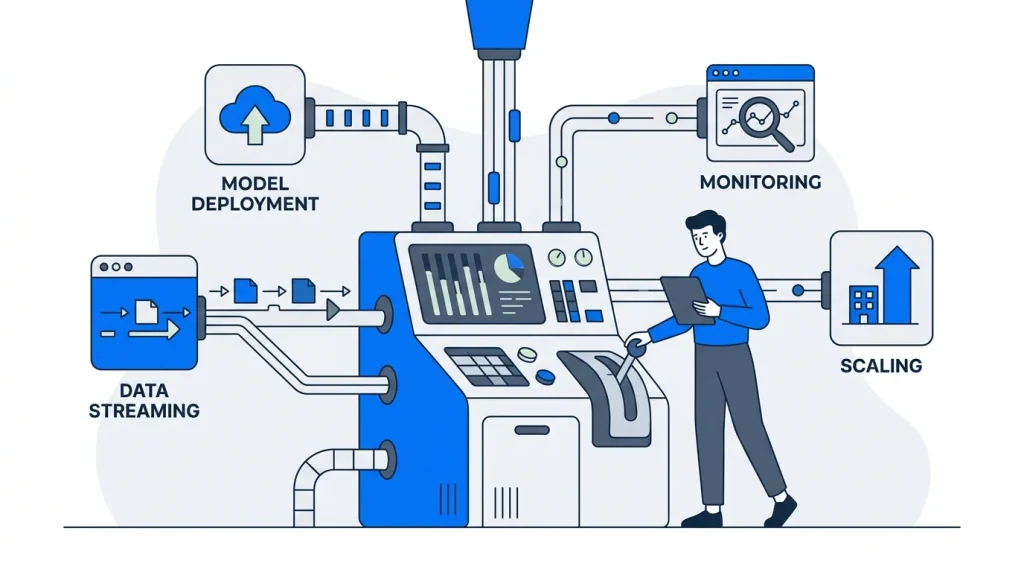
You just deployed your first machine learning model to production. The inference endpoint is live, the API is responding, and the executive team is thrilled. Then, week three hits. The data distribution shifts, inference latency spikes under user load, and your model silently starts making catastrophic, unmonitored decisions.
Welcome to the brutal reality of AI Model Deployment. The industry has aggressively moved past the honeymoon phase of asking if we should adopt machine learning. The only engineering question that matters now is how we orchestrate, observe, and scale these unpredictable systems without collapsing our existing stacks. This transition mirrors the exact trajectory of containerization. We are moving away from novelty and standardizing on cold, hard infrastructure.
Here is the technical reality of what it takes to build a deeply intelligent, resilient, and adaptable system.
The End of the “Proof of Concept” Era
The initial wave of enterprise AI was defined by standalone Jupyter notebooks and isolated proof-of-concept projects. Data scientists built bespoke models focused entirely on demonstrating raw business value. These early endeavors lacked the strict engineering rigor, CI/CD pipelines, and operational oversight we expect in traditional software development.
Deploying a single, static model to a server was treated as the finish line. In reality, it was barely the starting line. Managing the lifecycle of that model, ensuring its high availability, and integrating it into production workflows presented massive, unforeseen engineering hurdles. Teams quickly realized that a trained machine learning model is essentially just a serialized file.
To make that file useful, you need a sprawling ecosystem. You need real-time data ingestion pipelines, feature stores, robust inference servers, and continuous feedback loops. Building this ecosystem requires platform engineering, not just data science.
AI is Infrastructure Now: The Kubernetes Analogy
Comparing MLOps Infrastructure to Kubernetes is more than a convenient metaphor; it is an architectural roadmap. Before Kubernetes, managing containerized applications at scale was a nightmare of custom bash scripts. Engineers manually handled load balancing, service discovery, and self-healing mechanisms.
Kubernetes abstracted the underlying hardware by providing a declarative framework. You define the desired state of the system, and the control plane constantly works to maintain that state. This allowed developers to stop worrying about server provisioning and focus on application logic. AI systems are currently clawing their way out of their own pre-Kubernetes dark age.
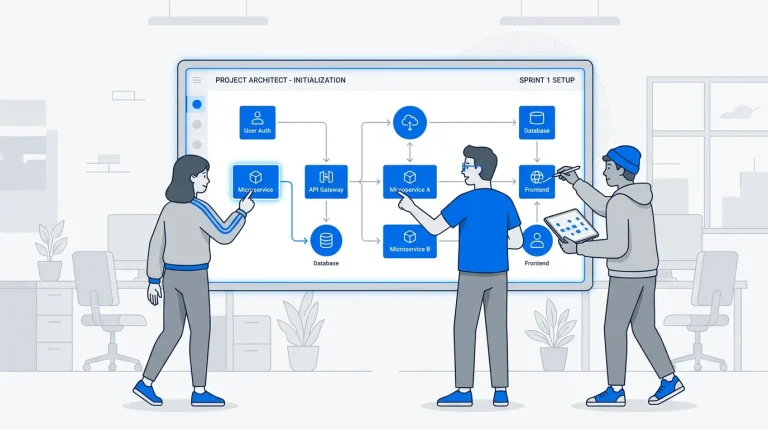
An AI application is rarely a monolithic construct. It operates as a web of interconnected microservices. Each component from data validation to the inference endpoint requires specific resource allocation, versioning, and continuous deployment practices. The industry requires platforms that automate this orchestration, bringing strict DevOps principles to machine learning workloads.
From Static Models to Dynamic Ecosystems
Orchestrating these components requires standardizing how data flows through your infrastructure. You cannot rely on manual retries or ad-hoc data cleaning scripts when your user base scales to thousands of concurrent sessions.
Platform engineers must build standardized APIs and promote strict interoperability between different machine learning frameworks. This modular approach ensures that swapping out an outdated model for a newly trained version does not require a complete system rewrite.
The Orchestration Imperative: Beyond the Endpoint
Transitioning your focus to Production-Ready AI Orchestration means looking past the initial deployment. It demands addressing the entire lifecycle and the harsh operational realities of running non-deterministic code in production.
Dynamic Scalability and GPU Bottlenecks
AI workloads, particularly during inference, generate highly variable traffic patterns. Your infrastructure must dynamically scale to meet fluctuating demand while efficiently allocating expensive hardware like GPUs and high-memory instances.
Static provisioning will either bankrupt your cloud budget or crash your service during traffic spikes. Modern orchestration platforms must manage these heterogeneous resources fluidly. This means dynamically routing inference requests across cloud clusters, on-premise servers, and edge environments based on real-time capacity and latency requirements.
Observability, Data Drift, and Silent Failures
Standard software fails loudly. If a database goes down, you get a stack trace and a 500 Internal Server Error. AI, however, fails silently. The API will return a 200 OK status code, but the prediction payload will be entirely wrong.
This happens due to data drift, where the real-world input data slowly diverges from the data used to train the model. You might also encounter concept drift, where the actual relationship between the input and the desired output changes over time.
Stopping silent failures requires aggressive, targeted observability. Engineers must monitor not just latency and CPU usage, but statistical performance metrics like precision, recall, and input distribution. If an anomaly is detected, the orchestration layer should automatically trigger an alert or route traffic back to a fallback heuristic.
Shadow Deployments and Version Control
Models, feature flags, and data pipelines evolve rapidly. An effective orchestration strategy must enable granular versioning of every single component in the pipeline. You cannot simply overwrite a production model and hope for the best.
- Shadow Deployments: Route a copy of live production traffic to your new model, but drop its predictions. Log the outputs to compare them against the live model’s performance.
- Canary Rollouts: Slowly direct a small percentage of real user traffic (e.g., 5%) to the new model to monitor for edge-case failures.
- Automated Rollbacks: If the new model violates predefined latency or accuracy thresholds, the system must instantly revert to the previous version without human intervention.
The “Plumbing” Trap: Avoid Building From Scratch
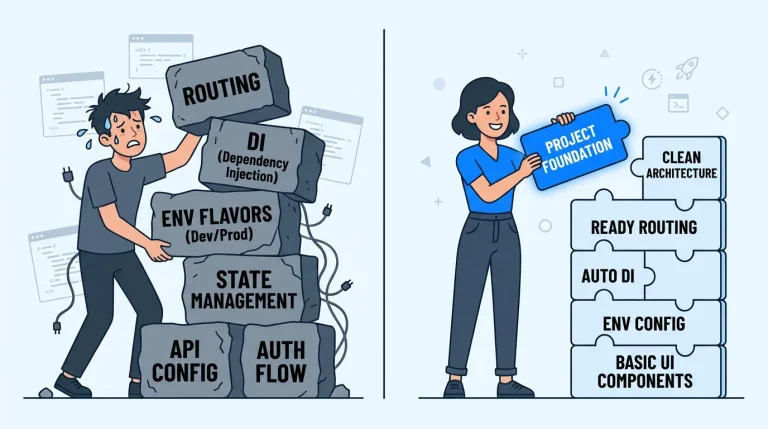
Architecting this intricate MLOps infrastructure from the ground up is a massive, highly expensive drain on engineering resources. It is the exact same trap development teams fall into when attempting to build complex, enterprise-grade mobile applications.
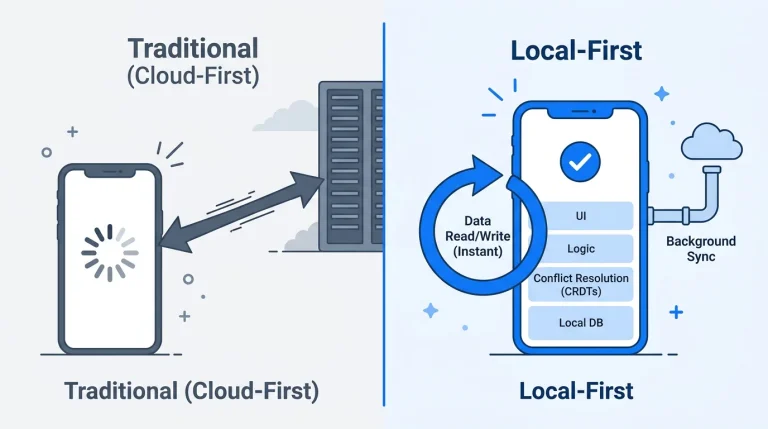
Consider the sheer amount of time wasted engineering offline-first mobile synchronization. Teams spend six to eight months fighting complex state management, writing Conflict-Free Replicated Data Types (CRDTs), and debugging local-first syncing before shipping a single feature. This boilerplate infrastructure work kills project momentum and drains budgets.
At Stacklyn Labs, we watch agencies burn thousands of hours re-inventing these fundamental architectural wheels. Whether you are orchestrating a distributed AI inference pipeline or managing complex data states across a mobile client, infrastructure boilerplate is the enemy of product delivery.
Utilizing a SaaS-in-a-Box architecture or integrating production-ready Flutter templates allows development teams to entirely bypass these foundational headaches. You plug into a pre-architected, battle-tested framework. This allows your engineers to focus entirely on application logic, user experience, and distinct business value, cutting months off your time-to-market.
Securing the AI Payload and Ensuring Governance
As AI integrates into critical business paths, security and governance shift from optional compliance checklists to mandatory architectural requirements. AI systems present unique, highly specific attack vectors that traditional Web Application Firewalls (WAFs) cannot catch.
Defending Against Novel Threats
Adversarial attacks involve malicious actors subtly altering input data to intentionally force the model into making an incorrect prediction. Protecting against this requires robust input sanitization and anomaly detection at the ingress layer. Additionally, the intellectual property embedded within the model’s weights and biases must be strictly protected via granular access controls and secure enclave environments.
Traceability and the Regulatory Landscape
Governance requires total transparency into how a decision was made. You need complete data provenance and model lineage. Engineers must be able to prove exactly which dataset trained a specific model, which hyperparameters were used, and who authorized the deployment.
With regulations like the European AI Act taking shape, auditable decision-making is mandatory. Your orchestration layer must facilitate Explainable AI (XAI) and guarantee reproducibility. If a user challenges an automated decision, your infrastructure must be able to trace that specific inference back to its exact origin state.
The Future is Orchestrated
The future IT landscape will treat artificial intelligence as a fundamental, standardized utility. It will become as heavily integrated and boring as DNS routing, network connectivity, or database replication. The subtle hum of machine learning processes optimizing supply chains, filtering threats, and personalizing interfaces will operate entirely behind the scenes.
The engineers and agencies who dominate the next decade will not be the ones writing the most mathematically complex algorithms from scratch. They will be the ones who figure out how to operationalize these tools securely, reliably, and profitably without wasting years building foundational plumbing.
Mastering the orchestration of AI, much like mastering offline-first mobile architecture, is not just about adopting a new toolset. It is about engineering a distinct, undeniable competitive advantage rooted in speed and infrastructural resilience.
References & Further Reading
- Google Cloud MLOps Guide: A comprehensive architectural framework detailing best practices for operationalizing machine learning and managing production orchestration challenges. Read more at Google Cloud MLOps Architecture.
- AWS Machine Learning Blog: In-depth technical discussions on the operational aspects of machine learning, focusing on scalability, monitoring, and automated lifecycle management. Explore the documentation at AWS ML Blogs.
- Gartner Reports on AI Infrastructure: Industry analysis tracking the maturation of AI technologies and highlighting the critical shift from model development to strict MLOps management.
- McKinsey & Company Insights: Strategic analysis on the operational realities of scaling enterprise AI, emphasizing governance, integrated platforms, and platform engineering. Research their findings at McKinsey Analytics & QuantumBlack.
Stacklyn Labs
Developer Notes & Updates